


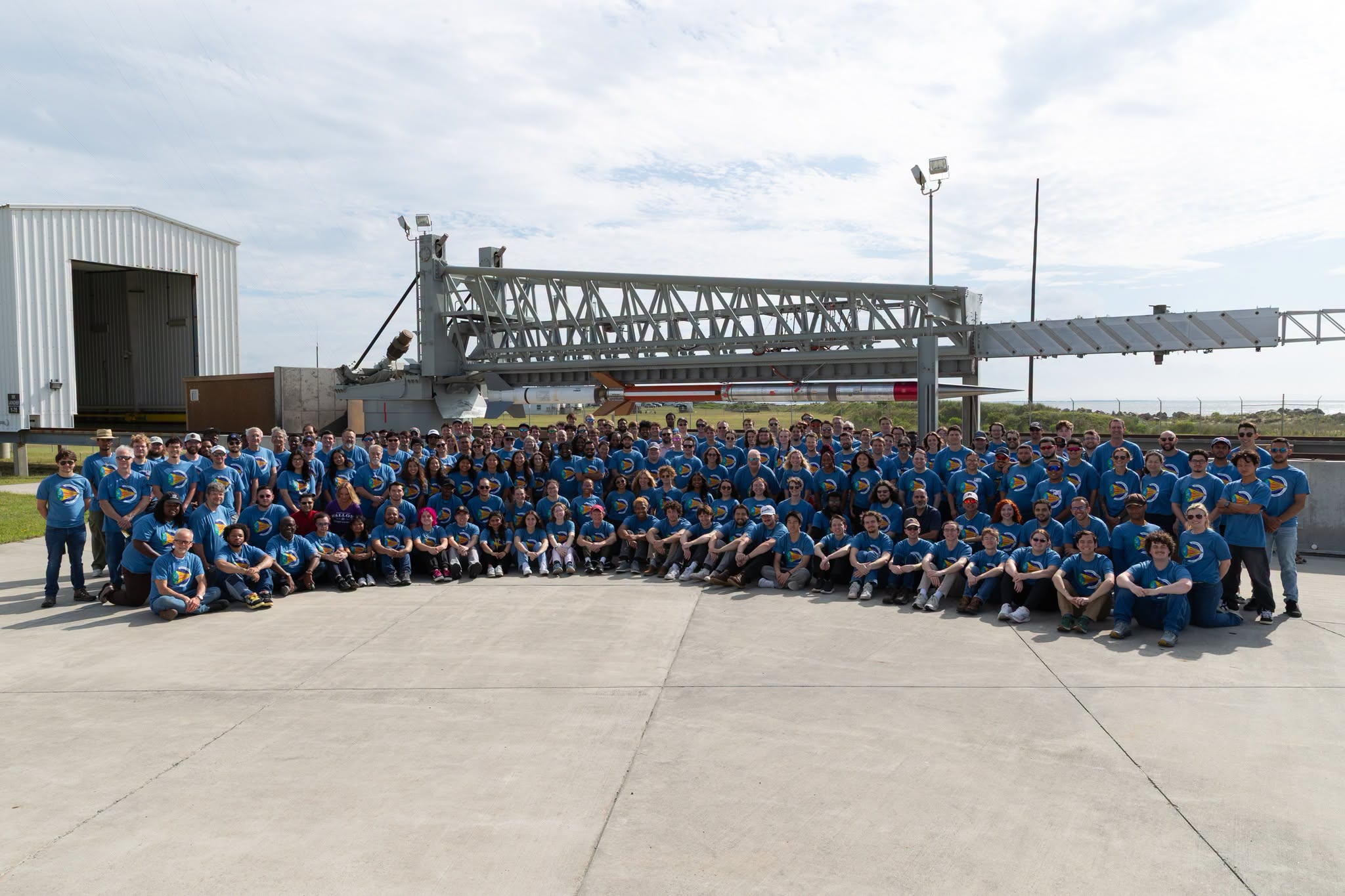
Students from Capitol Technology University's Observation and Detection Interpreted by Neural-networks (ODIN) payload team recently saw their hard work pay off as NASA’s RockSat mission launched on June 24, 2026. Aboard the sounding rocket was their contribution to the mission’s research efforts—a unique custom payload designed with artificial intelligence (AI) working as an “on-board scientist” that was trained to evaluate and prioritize scientific data during flight.
Marking the culmination of over a year’s worth of design, development, and testing activities, the ODIN team arrived at NASA’s Wallops Flight Facility in Virginia to witness their payload take flight. The RockSat Terrier Improved Malemute rocket climbed to an altitude of >200 miles before parachuting back to earth, equipped with payloads collecting data while it was in space.
A Cross-Functional Aerospace Team
The ODIN team—Philip Alsop, Zoé Denito, Eddie Zhou, Daniel Geer, Elijah Mister, Owen Coffee, Jason Gedlu, Taylor Fryer, James Gross, and Joe Moser—came together from across the astronautical engineering, data science, and computer science fields to create something incredible. They combined their skills to create a payload that could leverage the low power/cost AI GPUs now available. They then trained an AI model that could evaluate scientific sensor data and detect “interesting” data that could be prioritized for immediate transmission to the ground via an Iridium commercial communication antenna. The team was permitted to mount this antenna on the exterior of the NASA rocket as part of their payload.
This unique design allowed students on the ground to receive high-priority science data during flight, paving the way for future researchers who can take advantage of an AI “on-board scientist” when designing all types of aerospace payloads. This is especially useful in circumstances when getting data quickly to Mission Control is critical.
Designing a Payload for NASA
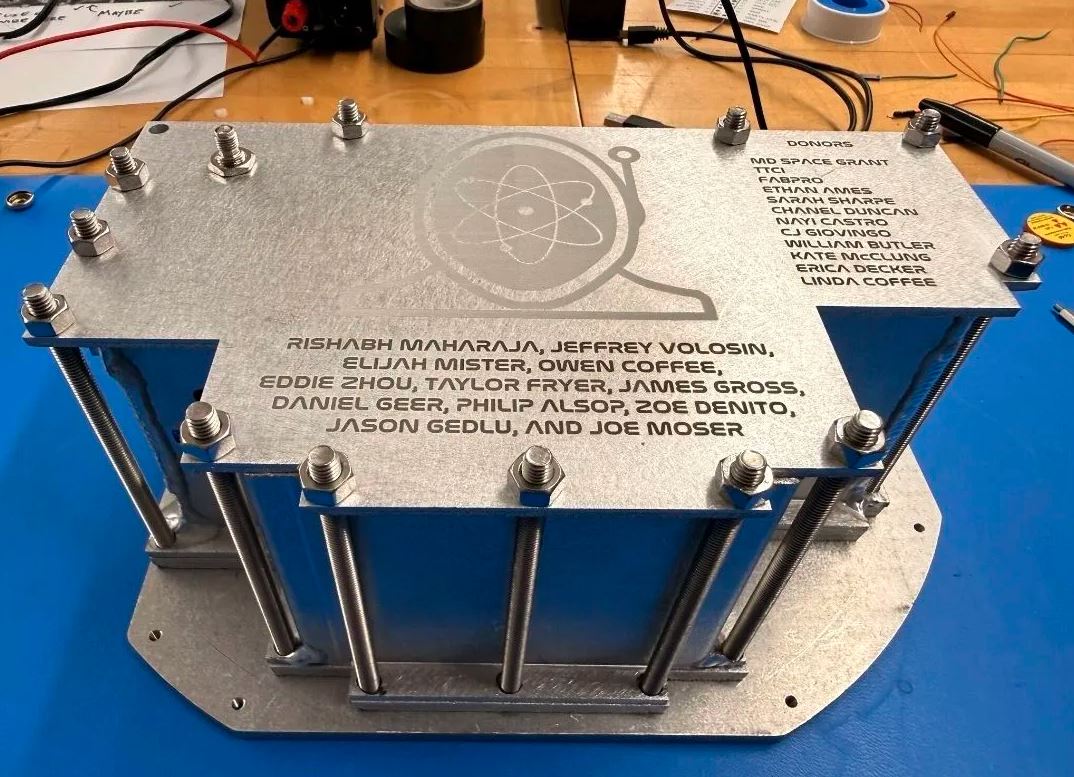
When designing a payload for NASA, it is important to focus not only on function but also, impact. With this in mind, our ODIN team stepped up to the challenge of developing something unique and forward-thinking.
Their payload was engineered to house two gamma-ray spectrometers arranged to measure the direction and energy level of impacting high-energy photons. It also notably included an onboard AI GPU trained on gamma-ray information sources for data interpretation. An Iridium satellite communication downlink antenna was used to stream high-priority science data identified by the AI model to a telemetry dashboard on the ground. The goal: to show the value of AI that can serve as a “scientist in flight,” ensuring that high-value data is captured and downlinked in real-time. These complex systems demonstrate how AI can enhance future spaceflight research.
Weeks before the launch, ODIN members worked alongside NASA engineers and technicians to integrate their payload directly to the sounding rocket. The ODIN team carefully tested the mechanical and electrical interfaces to ensure they functioned correctly and would perform as expected in-flight. During this process, students got a firsthand look at the rigorous NASA standards and attention to detail required throughout pre-flight operations.
Shortly before the launch, Capitol Tech’s RockSat team was joined by two Capitol Tech sophomores, Connor Trout and Julianna Allar, who were participating in NASA’s RockOn! Program that same weekend with our Astronautical Engineering Program Director, Jeff Volosin. While RockSat teams fly student designed, custom-built experiments, RockOn! provides students with the opportunity to assemble and launch a standardized scientific payload, introducing them to the fundamentals of spaceflight missions.
Payload Top-Rated by NASA Provides Data in Real-Time
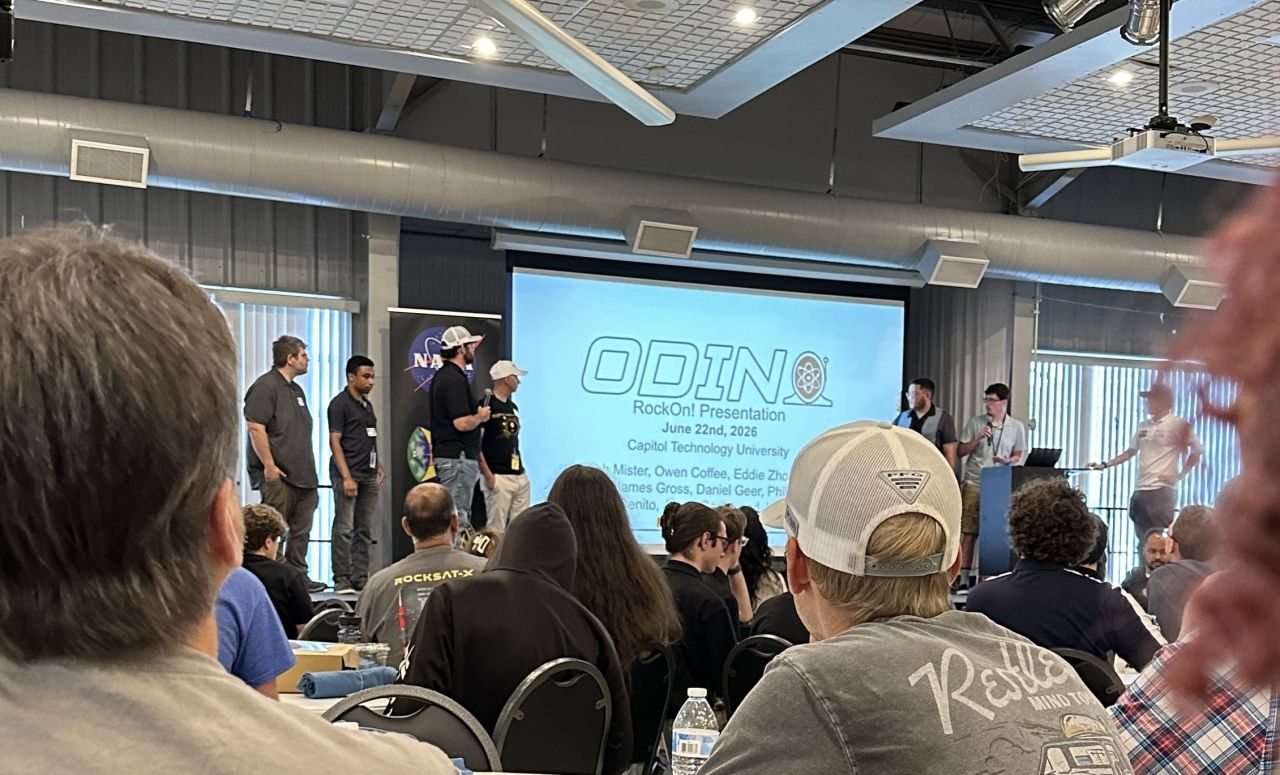
During development, NASA indicated that Capitol Tech’s ODIN payload was one of the top-rated projects of the 2026 RockSat mission. A key feature of the ODIN payload that NASA was interested in was the evaluation of the value of using AI GPUs to serve in an “on-board” scientist role, on both short duration sounding rocket missions as well as orbital missions. By training AI models in specific science disciplines, detector/sensor data from an experiment can be evaluated in real-time and “interesting” or “high priority” science data can be flagged.
For a short duration sounding rocket payload like ODIN, the AI prioritized science data can be transmitted in real-time to a ground receiving station, which ODIN used via the commercial Iridium network. These networks have limited bandwidth, making the prioritization of data to downlink a critical task—especially if the sounding rocket is not recovered and any on-board stored data is lost. For orbital missions and future missions to the Moon and Mars, on-board AI models serving as science assistants can quickly flag notable data for downlink or, on a human mission, can alert a crew member of a scientifically interesting finding.
Capitol Tech students overcame a number of challenges to package and operate the GPU on their mission. Concerns about power draw, thermal load, and sensitivity to launch were all evaluated, and measures were taken, to ensure a successful flight. Data flow tests were used with representative gamma-ray samples to train and evaluate the performance of the AI model’s predictions prior to flight. Now during post-recovery of the payload and data, students are evaluating the AI's performance and will be drafting a paper to ensure that others considering training AI models for flight systems can benefit from this experiment.
Expert Faculty and Industry Partnerships for Success
In addition to Capitol Tech leadership on this project—Jeff Volosin, a former NASA senior leader with a 40-year aerospace career, and Adjunct Professor Rishabh Maharaja, Principal Investigator (PI) for this project with a 15-year aerospace career—students also worked with local industry partners who donated their time and expertise to ensure the ODIN payload was ready for flight. The Test Connection, Inc. (TTCI) in Hunt Valley, MD provided support for the layout and testing of ODIN's electronic circuitry, and Fabpro Technologies in Halethorpe, MD provided support for the fabrication of the ODIN aluminum structure. In addition, the Maryland Space Grant Consortium (MDSGC) provided invaluable grant funding to support the development of the ODIN payload. On launch day, students joined fellow peers from nineteen universities from throughout the country who were also chosen for this mission—all while networking, making friendships, and learning about the other payloads. The opportunity was once-in-a-lifetime.
Aerospace Education at Capitol Tech
Experiences like these showcase the breadth of Capitol Tech's Astronautical Engineering program. Students are given the opportunity to work on different stages of an aerospace project lifecycle, from theory to experimentation to development to launch. Projects include high-altitude balloon experiments, high-power model rocketry, sounding rocket payload development, and even a unique combination project that develops “rocket-balloons (rockoons)” that can place student payloads into the ionosphere and hopefully in the future, to the Karman line. Capitol Tech's commitment to experiential learning gives students access to skills development rarely available in a traditional classroom, preparing them for successful careers straight out of college.