


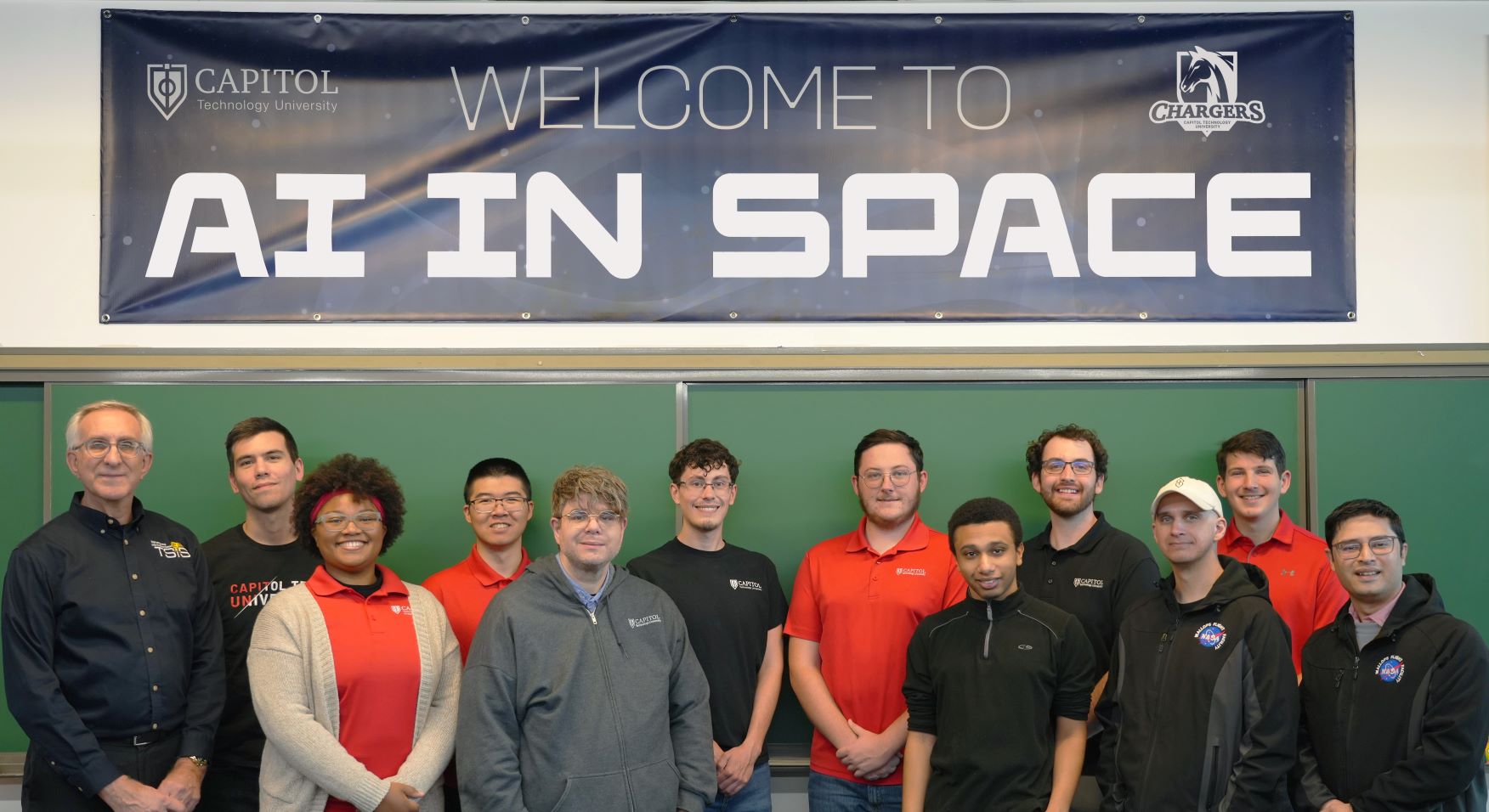
In an outstanding student achievement and a proud moment for Capitol Technology University, NASA announced the official selection of our ODIN team’s payload for the RockSat 2026 sounding rocket flight.
The ODIN (Observation & Detection Interpreted by Neural-networks) team is comprised of ten Capitol Tech students who developed a payload with advanced sensors and onboard AI capable of interpreting data in real time. This novel approach sets their work apart in the competitive field of student space engineering.
NASA selected ODIN for a coveted spot on the RockSat mission based on the scientific merit of the team's proposal, the feasibility and technical maturity of their design, and clearing by the Wallops Flight Facility in Virgina. Out of 24 universities competing, only 12 payloads were selected—making this a highly competitive endeavor and a great success for our students. The rocket is scheduled to launch on June 25, 2026.
ODIN’s Student Leadership
ODIN is a Senior Design Capstone project led by ten seniors from Capitol Tech’s astronautical and space engineering, data science, and computer science programs: Philip Alsop, Zoé Denito, Eddie Zhou, Daniel Geer, Elijah Mister, Owen Coffee, Jason Gedlu, Taylor Fryer, James Gross, and Joe Moser.
The team has been working together to transform classroom knowledge into flight‑ready hardware, motivating one another through the demanding milestones of design, integration, and testing. With faculty guidance, they are responsible for the technical development of both the flight and ground segment where they create the payload, as well as a telemetry dashboard that will display live data during flight.
This project highlights both the rigor of the capstone experience and the dedication of students who balance coursework with the challenges of building real‑world systems. Students utilize model-based system engineering and traditional systems engineering methodologies, astronautical engineering, electrical engineering, software engineering, AI integration, flight software, ground segment development, structural and thermal developments, programmatics, cyber security, and much more.
Mentorship by Expert Faculty
Guidance and instruction from our Astronautical and Space Engineering (ASE) faculty strengthens this on-going project. Professor Jeff Volosin, a former NASA project and program manager with a 38-year aerospace career and Chair of the ASE program at Capitol Tech, structured the courses to emphasize student leadership while providing faculty direction and concept overviews.
Adjunct Professor Rishabh Maharaja, has led many sounding rocket payloads from Capitol Tech. He currently works for the Federal Aviation Administration’s Commercial Space Transport Office. Formerly, he was a Systems Review Manager at Goddard Space Flight Center and Lead Mission Operations Assurance Engineer for NASA’s James Webb Space Telescope, providing technical expertise and oversight.
Professor Maharaja is the Principal Investigator (PI) for this project and meets with the student team weekly to provide guidance and ensure steady progress. Many of the concepts and practices from this project are directly integrated into his Systems Engineering (AE 325) course, reinforcing classroom learning with real-world application.
“Our students have demonstrated extraordinary teamwork, relentless hard work, and inspiring leadership—combining ingenuity with dedication to achieve results that reflect both their talent and collaborative spirit,” said Professor Maharaja. “They apply knowledge gained in the classroom to real-world challenges while embracing NASA’s systems engineering approaches and Golden Rules, showcasing the power of disciplined innovation. RockSat is a challenging program that demands full dedication, often requiring our students to burn the midnight oil while balancing coursework and exams, yet they manage this exhaustive workload with remarkable morale and unwavering commitment.”
Payload Development
The ODIN payload will occupy a quarter-space position in the RockSat rocket’s pressurized section, with access to a Multi-Purpose Port for its Iridium antenna. The payload features:
- Two spectrometers for radiation and compositional data.
- Onboard AI for real-time interpretation with computation provided by a GPU.
- An Iridium downlink that streams telemetry to telemetry dashboard developed by students.
“There is a lot of work ahead to complete the design and finish the flight test and flight build,” said Professor Volosin. “But ODIN’s strong design was graded highly by NASA. Their payload combines x-ray/gamma-ray detection with an artificial intelligence agent, evaluating data during the flight and prioritizing science data of interest for downlink on their Iridium link. The goal is to show the value of on-board AI that can serve as a ‘scientist in flight,’ ensuring that high-value science is captured and downlinked ASAP.”
These complex systems allow the team to monitor live data and further demonstrate how AI can enhance future spaceflight research.
NASA also awarded Capitol Tech with a grant in support of the mission. With the initial round of reviews completed, the team is now preparing for the Critical Design Review in December of 2025 as they move toward launch.
Special Thanks
The ODIN team would like to thank the following supporters:
The Test Connection, Inc. (TTCI) for serving as the industry liaison for the ODIN project, providing guidance on system integration, test strategy, and mission-readiness considerations.
Antoine Hutchinson at FabPro Technologies Inc., based in Halethorpe, MD, for sponsoring payload fabrication and materials costs.
Systems Engineer Daniel Bottner for providing design-related guidance and supporting the University's payload development in the past. Daniel has built 3 payloads over the years, and for ODIN, he has provided review-like support for the design and will also be on standby if needed.
Physicist Dr. Azita Valinia for her science-related support. Dr. Valinia is a former senior NASA executive, strategist, and interdisciplinary technical leader with over two decades of experience spanning positions as Chief Scientist, Director of R&D, and Program Manager.
Our ASE Faculty: Bob Scheid, Marcel Mabson, Glenn Bock, and Ted Drilling for their reviews and support.