


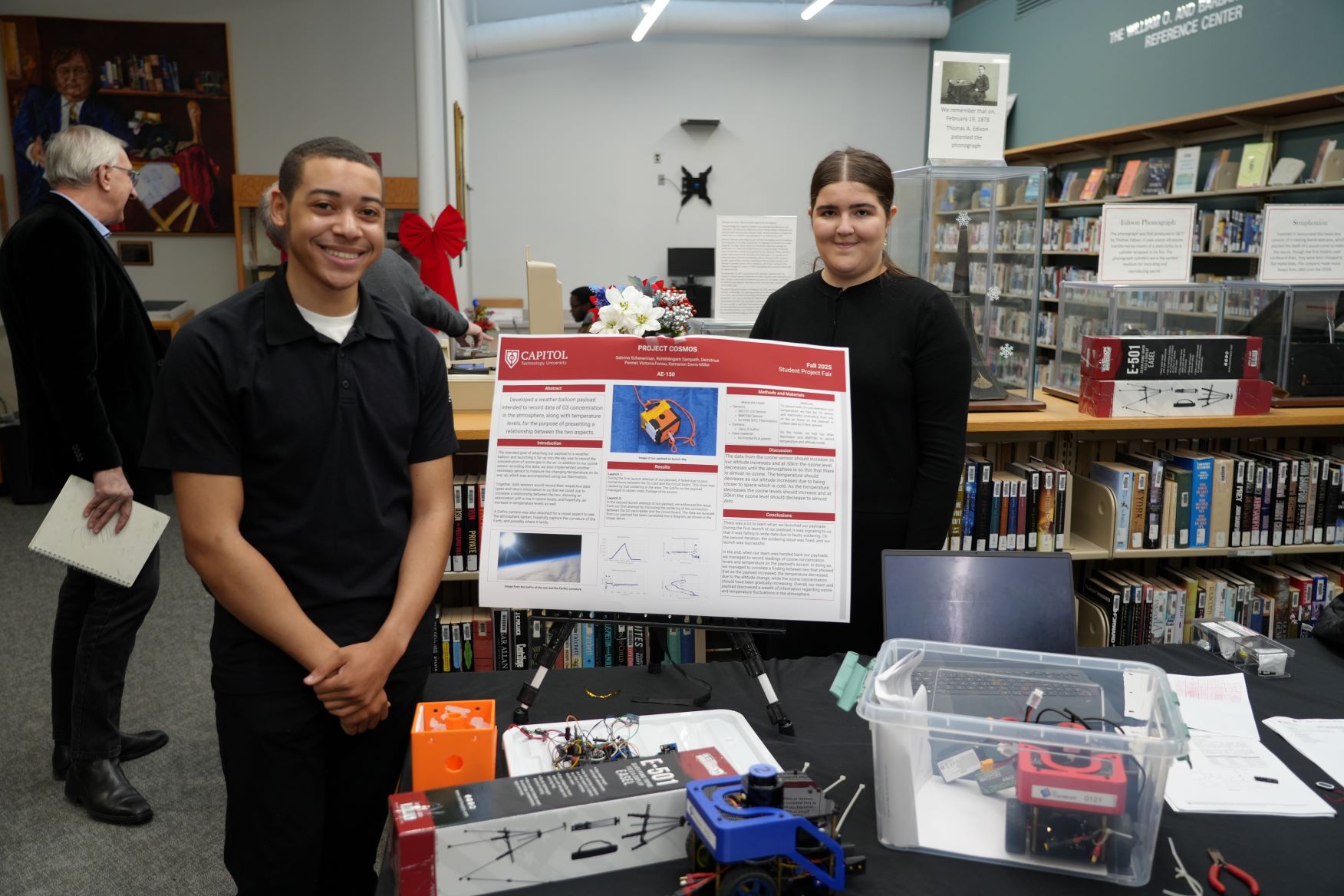
Students in Capitol Technology University’s Introduction to Space course concluded the Fall 2026 semester with a successful high-altitude balloon launch, sending their custom payloads into the upper atmosphere after months of development.
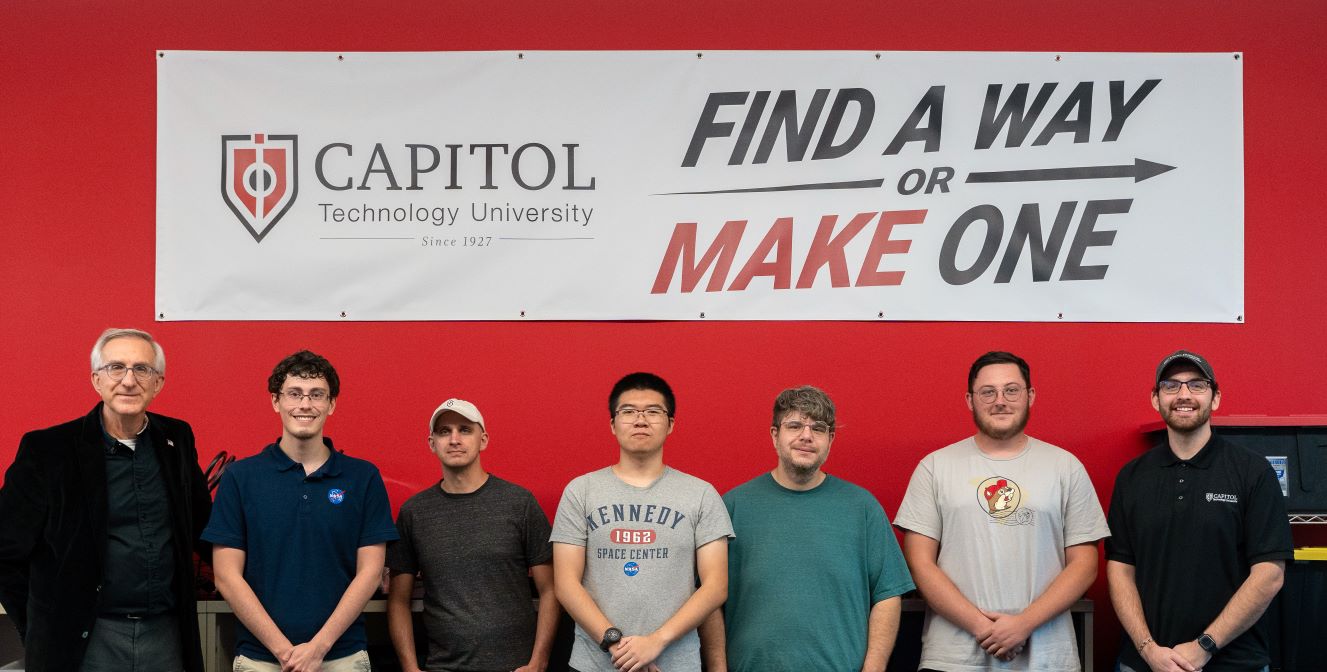
The course’s unique teaching model enabled six upper-class lab managers to lead students through design, build, and testing, supported by oversight and mentorship from Astronautical and Space Engineering Chair Jeff Volosin. Having students teach other students reinforces their own understanding while also creating a unique platform for collaboration and shared growth.
Taylor Fryer, a Data Science senior and lab manager, described the class and process: “Building and testing these payloads pushed them to get their hands dirty, break things, fix them, and understand how problem-solving works. That kind of trial-and-error is a big part of becoming an engineer.”
Building the Payloads
Over the course of three months, teams tackled the challenge of creating payloads capable of collecting environmental data while attached to a science balloon. The work required integrating sensors, electronics, structural components, and flight-ready software.
Astronautical and Space Engineering junior at Capitol, Desmond Pearson said the most demanding aspect was programming the flight board.
“The most challenging part of the payload build was writing the code for the board. My team and I had to pull from older GitHub examples and compare what other groups were doing to make sure everything worked together. We shared ideas, debugged issues, and slowly pieced everything together.”
During the building process, students encountered a variety of technical challenges that tested their problem-solving skills and teamwork. But these pivots highlighted the hands-on nature of the course, where students learn not just design principles but also how to troubleshoot and adapt under real-world constraints.
“The lab managers were critical to the success of this class,” Professor Volosin said. “They developed the training material, ensured we met standard ballooning requirements, taught the skills-based content, supported each team throughout their builds, participated in reviews to confirm readiness, assisted at the launch site, and captured lessons learned to improve the course for next fall.”
Lessons Learned in Systems Engineering
Throughout the course, students also gained insight into how complex space missions truly are. Pearson said the experience shifted his understanding of aerospace engineering.
“One thing I learned that really changed my perspective is how much systems engineering goes into every mission. Before, I thought of space missions as mainly rockets and astronauts, but now I understand how many subsystems must work together perfectly—communications, sensors, thermal protection, power, structure, and more.” Even small mistakes, he realized, can compromise an entire mission.
Volosin said these early engineering lessons will continue to shape future coursework, and he plans to recruit Fusion Lab managers next semester to help refine payload builds and support more students in their own balloon projects.
Launch Day
And finally, after weeks of planning, assembly, and testing, the students’ work came to life during launches on November 15 and November 22.
“Watching the payload launch felt surreal. It’s one thing to build something in class but seeing it actually go into the sky makes it feel real—like something an actual engineering team would do,” Pearson said.
The flight revealed just how extreme near-space conditions can be. Students observed significant temperature drops, changes in UV levels, and other environmental factors that affected their payloads, including much colder internal temperatures than anticipated. These results highlighted the importance of careful thermal design and reinforced lessons about how real-world conditions often differ from classroom simulations.
The first balloon launch reached roughly 85,000 feet. After re-working their designs based on lessons learned, the teams prepared second launches that reached a maximum height of 90,000 feet. Both opportunities gave the students complex data to analyze and research for air quality, magnetic data, gravitational findings and more.
“Looking ahead to next semester, course graduates will update training materials, refine build guidelines, and develop improved payload prototypes as we work to increase reliability, enhance packaging and power, and better manage internal temperatures,” Professor Volosin said. “Our goal is to expand Capitol’s role in high-altitude ballooning, support the next flight in April, and begin exploring RockOns, which combine balloon flights with high-power model rockets.”
The launches marked a meaningful milestone in the students’ learning, offering a practical introduction to aerospace engineering principles.
“The most interesting part for me was seeing the data they brought back and watching them piece it together into a story of the flight,” Fryer said. “Instead of treating it like a pile of numbers, they started connecting altitude changes, temperature drops, and sensor behavior to what was happening moment by moment. It turned the flight from an event into something they could visualize and explain.”
With guidance from upper-class lab managers and faculty oversight, students built the confidence and foundational skills needed to take on more complex engineering challenges in future courses—exactly the kind of hands-on education, connection, and innovation that lies at the heart of Capitol Tech.